Showing posts with label azure. Show all posts

Tuesday, July 14, 2015

RDS Deployment template available in Azure Resource Manager!

The RDS team did a great blog post on using the RDS Deployment template for Azure Resource Manager. Azure Resource Manager enables you to work with the resources joined as a group and allows you to deploy, update or delete all of the resources for your purpose in a single, coordinated operation. Using a Azure Resource Manager Template you can very easily setup a environment (in this case RDS) and deploy that as a group of resources. Azure Resource Manager is the Management API layer for the future Microsoft Cloud!

I took the RDS template for a test-drive, the result was pretty impressive. A full RDS deployment up & running!

This is what the template creates for you:

  • VNET
  • New storage account
  • Public IP resource
  • Load Balancer resource, including the correct ports opened 
  • VM for Active Directory and DNS server roles
  • VM for RD Gateway and RD Web Access server roles
  • VM for RD Connection Broker and RDS License server roles
  • VMs for RD Session Host (RDSH) servers.
  • A Basic ADDS deployment
  • A RDS Full Desktop Deployment, incl. RD Gateway, Licensing etc.

image

After the Azure Resource Manager template deployment finishes, you end up with a working RDS deployment, accessible from the outside, ready to do testing for a POC, testing customizations etc.

image

The only thing not configured is obviously SSL certificates. Which means you will end up with a self signed certificate. This can however be changes easily by providing the SSL certificate in the RDMS on the RD Connection Broker server.

Obviously this is not production ready, but what’s also cool about Azure Resource Manager Templates in general is that you can create your customized template, for example basing it on the one for RDS that’s being provided and start building your own template.

image

To open the template directly from you subscription click the icon below.

image

More information on the RDS template here: http://azure.microsoft.com/en-us/documentation/templates/rds-deployment/ 

Link to the RDS Team blog article: http://blogs.msdn.com/b/rds/archive/2015/07/13/azure-resource-manager-template-for-rds-deployment.aspx?utm_source=dlvr.it&utm_medium=linkedin

More overall information on Azure Resource manager:
https://azure.microsoft.com/nl-nl/documentation/articles/resource-group-overview/

Thursday, July 9, 2015

Adding Conditional Access & MFA to Azure RemoteApp

(Originally posted on rdgurus.com)

Because the Azure RemoteApp client authenticates against Azure Active Directory (AAD) we are also able to leverage Conditional Access and Multi Factor Authentication (MFA) based on AAD. The RDS Product team also recently announced this in the blog post Control access to Azure RemoteApp with Azure AD Conditional Access!

In this blog post I’ll guide you through the process of setting up MFA on Azure RemoteApp.

First of all, Conditional access requires Azure AD Premium (currently in preview). You can however set this up in a 30 day trial. To do that, open the Azure Portal browse to your AAD and choose the option “TRY AZURE ACTIVE DIRECTORY PREMIUM NOW”

image

Confirm the agreement belowimage

It take a few minutes to setup. Click the refresh link to be able to start using it.

image

Shortly followed by that, you should receive a confirmation email that the organization is ready for Azure AD Premium.

image

To configure MFA, reopen the Azure Portal, go to Active Directory open your AAD domain en choose Applications.

image

Now click on Microsoft Azure RemoteApp and go to the Configure tab. For this demo, we’ll select Enabled Access Rules, have it applied to all users, and select Require multi-factor authentication.

image

The next time we log on to the Azure RemoteApp client with an organization account from this AAD, we are presented with the following;

image

This is MFA kicking in. We click “Set it up now”. And without having to leave the Azure RemoteApp client, we’re being presented the ability to provide a phone number and verification type that we would like to use for this account. In this case I choose Phone Authentication, and provide my cell number. (we obviously only have to perform these steps once).

image

When we click Contact me, Azure MFA will call me on the number provided to verify the correct number.

image

The verification process is now completed and we are ready to use MFA for Azure RemoteApp.

image

When proceeding the logon in the Azure RemoteApp client we’re presented with the following screen indicating that we can expect a call to our provided phone number to perform the MFA !

image

And after that, we’re presented with the RemoteApps assigned to us based on the Azure RemoteApp Collection.

image

There are some other options in conditional Access policy worth mentioning. We can for example specify to only enforce MFA when people are connecting from outside of the corporate (trusted) locations, or even block access in those cases.

image

By clicking the link, we’re able to configure these trusted locations, configure whether or not we want to allow app passwords and even allow users to suspend multi factor authentication from remembered devices.

image

This blog post was originally posted here:
http://www.rdsgurus.com/azure-multi-factor-authentication/adding-conditional-access-mfa-to-azure-remoteapp/

Monday, April 13, 2015

Manage users in Azure RemoteApp based on Active Directory groups, with PowerShell!

Prior to December 11/12/2014 Azure RemoteApp supported functionality to authorize users to an Azure RemoteApp Collection based on Azure Active Directory group membership.

image

However, this feature was deprecated starting from 11/12/2014. Also see: As of 11/12/2014 ‘Active Directory group’ support for Azure RemoteApp will be deprecated.

The statement that Microsoft made related to this change:

“…Continuous changes to user groups' membership, especially when that group owner is different from RDS admin, make billing and usage less predictable. Because of this, we are deprecating user group support in Azure RemoteApp…”

As a result, the only way to add users in bulk is using the .CSV bulk import option. You can find more info on that here: Introducing CSV based user import

To allow for easier management I wrote a PowerShell Script that synchronizes users to a Azure RemoteApp Collection based on Active Directory Group Membership.

The script will do the following, based on a specified Active Directory group & Azure RemoteApp Collection;

- Add users to an Azure RemoteApp collection who are a member of the AD group
- Remove users from an Azure RemoteApp collection who are not a member of the AD group anymore

This will result in only allowing access to, and being billed for, users that are added to an Active Directory group.

Below is a sample output in a scenario where 4 new users were added to the group and 4 other users were removed. When finished the scripts outputs the users currently allowed access to the Collection.

image

If needed you could create a Scheduled Task, or maybe even better in Azure Automation and have this run periodically and include the action to add users to the AD group in your current Identify Management solution.

The Azure Portal below reflects the changes instantly.

image

I uploaded the PowerShell script to TechNet Gallery, get the link here:

https://gallery.technet.microsoft.com/Manage-users-in-Azure-f793aea7

The PowerShell script obviously requires the modules of both Active Directory and Azure and a Azure Publish Settings file to be able to connect to Azure for Remote Management.

2 notes of caution:

- Any user that is not a member of group specific in the script will be removed from the Azure RemoteApp Collection, without a warning. So make sure the group contains all users that need access to the collection

- You will be billed by Azure based on the number of users that have been allowed access. So make sure that the group specific in the script only contains members that actually need access.

Tuesday, February 3, 2015

Azure RemoteApp, update on Pre-build image

The Office 365 ProPlus pre-build image for Azure RemoteApp has been updates now including several new applications.  as you may know, Azure RemoteApp Cloud deployment comes with 3 different pre-build RDSH images.

As of last week, the following has been added to the Office 365 ProPlus image;

  • SQL Native client
  • ODBC Driver
  • SQL Server Data Mining client
  • MasterDataServices client
  • Microsoft Publisher
  • PowerQuery
  • PowerMap

To use this image, make sure you select the 28-1-2015 version of the Office 365 ProPlus image.

image

Exploring the Azure RemoteApp User Experience

imageThe Microsoft RDS team released a new blog post on the User Experience of Azure RemoteApp. In several recorded demo’s they show the Local-like Productivity, Multi-platform support and performance!


image

image

image

Source & more info: http://blogs.msdn.com/b/rds/archive/2015/02/02/exploring-the-azure-remoteapp-user-experience.aspx?wa=wsignin1.0

Thursday, December 11, 2014

Azure RemoteApp is GA, previously created Previews are changed to a 30-day trial

It’s December 11th today, which means Azure RemoteApp is now officially generally available.

If you previously signed up the the Free Preview, that preview is now automatically changes to a 30-day trial. If you open the Azure Portal and browse to your Azure RemoteApp you will be notified with the ability to activate the service.

image

For more info on Azure RemoteApp also see: azureremoteapp.net or join the LinkedIn group here https://www.linkedin.com/groups/Microsoft-Azure-RemoteApp-7401732

Friday, December 5, 2014

Azure RemoteApp Series – Weekly Ask the Experts Webinar

Yesterday was the announcement on the GA date of Microsoft Azure RemoteApp, December 11th, 2014. Basically, next week! :) Back in October I attended TechEd Europe in Madrid, staffing the Microsoft Desktop Virtualization booth, which was fully dedicated in Azure RemoteApp. Back then, the interest and attention for this service was already huge. Overall, the interest for the service has been growing a lot over the past few months.

The Remote Desktop Services team is running a Azure RemoteApp Series – Weekly Ask the Experts Webinar series, you can join here to attend the webinars:

image

https://azureinfo.microsoft.com/US-Azure-WBNR-FY15-11Nov-AzureRemoteAppAskTheExperts-Registration-Page.html

And here are some links of recordings of previous sessions:

11/19 webinar  https://wcc.on24.com/webcast/previewlobby?e=897606&k=771C3CB420F89654082297C28BC5626B

12/3 webinar https://wcc.on24.com/webcast/previewlobby?e=903716&k=2D5579C2FB7DECCB3E33B007C4F177BC

Wednesday, December 3, 2014

Azure RemoteApp (ARA) now supporting Office 365 ProPlus!

The Microsoft RDV Team released a new bog post about support for Office 365 in Azure RemoteApp (ARA). This means that you can now publish Office 365 ProPlus applications as a RemoteApp to your end-users!

As a results, you can now choose from three different Microsoft Images to create Azure RemoteApp cloud collections which are available out of the box in Azure!

image

Below is a description of the images currently available today!

Windows Server 2012 R2 (a.k.a. "the vanilla image")

  • This image is based on Microsoft Windows Server 2012 R2 Datacenter operating system and has the following roles and features installed to meet the requirements of Azure RemoteApp template images:
    • .NET Framework 4.5, 3.5.1, 3.5
    • Desktop Experience
    • Ink and Handwriting Services
    • Media Foundation
    • Remote Desktop Session Host
    • Windows PowerShell 4.0
    • Windows PowerShell ISE
    • WoW64 Support
  • This image also has the following applications installed:
    • Adobe Flash Player
    • Microsoft Silverlight
    • Microsoft System Center 2012 Endpoint Protection
    • Microsoft Windows Media Player

Microsoft Office 365 ProPlus (Office 365 Enterprise E3 or E4 subscription required)

  • Office 365 is the most requested application and therefore we have provided you with a pre-created "custom" image for you to work with.
  • This image is an extension of the vanilla image and has the following components of Microsoft Office 365 ProPlus installed in addition to the components described in the Windows Server 2012 R2 image:
    • Access
    • Excel
    • Lync
    • OneNote
    • OneDrive for Business
    • Outlook
    • PowerPoint
    • Project
    • Visio
    • Word
    • Microsoft Office Proofing Tools
  • Full functionality of Office 365 ProPlus apps is available only for users who have Office 365 Enterprise E3 or E4 subscriptions. Please contact your Microsoft account representative for more details on Office licensing.

Microsoft Office 2013 ProPlus (trial only)

  • During the preview, we thought that it would be good idea to provide a pre-created "custom" image for you to test the service with.
  • This image is an extension of the vanilla image and has the following components of Microsoft Office 2013 ProPlus installed in addition to the components described in the Windows Server 2012 R2 image:
    • Access
    • Excel
    • Lync
    • OneNote
    • OneDrive for Business
    • Outlook
    • PowerPoint
    • Project
    • Visio
    • Word
    • Microsoft Office Proofing Tools
  • Our legal team wanted us to emphasize: This image does not include Microsoft Office license and hence cannot be used for production. Office 2013 ProPlus is for preview only and if you want to use Office apps in Azure RemoteApp for production, please use Office 365 ProPlus image. For more details on Office licensing, please contact your Microsoft account representative.

Source and more info: http://blogs.msdn.com/b/rds/archive/2014/12/02/azure-remoteapp-now-supporting-office-365-proplus.aspx

Monday, November 24, 2014

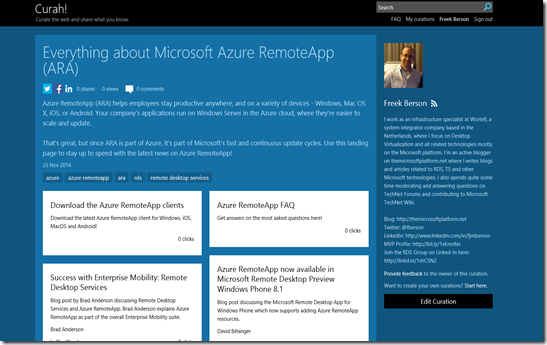
Microsoft Azure RemoteApp (ARA) on Curah!

What is Curah!
Curah! is a new curation service specifically designed for and maintained by the technical community. With curations we aim to get users where they need to go faster and more reliably with aggregated-answer data, helpful advice, and prescriptive guidance.

Why a curation on Azure RemoteApp (ARA)?
Since ARA is part of Microsoft Azure platform, it's also part of Azure’s fast and continuous update cycles. The “Everything about Microsoft Azure RemoteApp (ARA)” Curation will provide you with a consolidated view of the latest news, combined with direct links to downloads related to ARA, in an easy to navigate format. To accommodate an easy entry I created azureremoteapp.net to point to this new curation!

Happy reading!

image

Thursday, November 20, 2014

Support for groups in Azure RemoteApp (ARA) will end in 10 days

If you are using the Azure RemoteApp (ARA) Preview you previously had the option to grant users access to ARA using Active Directory Groups (for Hybrid Scenario’s).

Note that this support will end soon: on November 30, 2014. To ensure continuity, any user group assignment you have before today will continue to work until November 30, 2014. All users in current groups will still have access , even though the groups are not shown on the User Access page.

If you have signed up for the ARA Preview, you should have been notified via e-mail on November 6th.

After this date, you will need to assign permissions per user. The reason behind this is making billing and usage simple and predictable. Microsoft has not disclosed pricing and SLA to the public yet.

imageTo make life a little easier, you can use a CSV based import. Click the Bulk Add Users option to upload a .CSV containing a list of e-mail addresses.

image

Using a bulk import is of course a step back in regards to easy of management, but it apparently had to be done to be fully prepared for the upcoming billing model. Will it return as part of Azure’s fast release model?  let’s hope so! :)

Tuesday, November 11, 2014

Additional guidance published on: RemoteApp and Remote Desktop Session Host Farm Deployment Guides

Clark Nicholson from the Remote Desktop team has published additional guidance on previously released deployment guides on Microsoft Azure Desktop Hosting: RemoteApp and Remote Desktop Session Host Farm Deployment Guides. This also includes scripts to automatically scale down RD Session Host servers to save costs in an Azure Scenario.

Hello everyone, this is Clark Nicholson from the Remote Desktop team. We have just published additional guidance to extend a basic Remote Desktop Services (RDS) deployment in Azure virtual machines. The RemoteApp Programs Deployment document provides steps to create a RemoteApp collection. This allows users to access Windows applications that are running in Azure virtual machines from their favorite internet connected devices.

The Remote Desktop Session Host Farm Deployment document provides steps to add RDSH servers to RemoteApp or desktop collections to create RDSH server farms for higher availability and scale out. Once an RDSH farm has been created in Azure, the RDSH scaling script can be deployed to automatically stop and start RDSH server VMs to reduce VM costs.

These documents assume that a basic RDS deployment has been created based on the Windows Azure Desktop Hosting Reference Architecture Guide and the Windows Azure Desktop Hosting Deployment Guide. For additional information, please see Remote Desktop Services and Microsoft Azure Virtual Machines.

Note: Questions and comments are welcome. However, please DO NOT post a request for troubleshooting by using the comment tool at the end of this post. Instead, post a new thread in the RDS & TS forum. Thank you.

Source: http://blogs.msdn.com/b/rds/archive/2014/11/10/microsoft-azure-desktop-hosting-remoteapp-and-remote-desktop-session-host-farm-deployment-guides.aspx

Monday, September 22, 2014

Microsoft Azure RemoteApp, taking a closer look at the Hybrid Deployment

1. INTRODUCTION
I’m sure you’ve all heard about Azure RemoteApp by now. If not, see https://www.remoteapp.windowsazure.com/ for more details. Currently Azure RemoteApp is still in preview, so you can try it out for free.

Azure RemoteApp comes is two different deployments, a Cloud Deployment and a Hybrid Deployment. Cloud deployment means the RD Session Host servers that run your Azure Remote Apps are not connected to your on premises Active Directory Domain and can therefor only interact with application and data on the RD Session Hosts itself. Hybrid Deployment means the RD Session Host servers are connected to your on premises environment and are also members of your on premises Active Directory Domain, connected via Azure Active Directory. This means these RD Session Host servers and the users it serves, are able to access resources like file servers, application servers, SQL servers etc. that are hosted on premises.

The Cloud deployment is very straight forward to set up and you can have that up and running in no time. Previously the Cloud Deployment only supported using the RD Session Host template provided by Microsoft Azure. This has changed since August 2014 when Microsoft announced the support to use your own RD Session Host template for Cloud Deployments as well.

In the mean time, Microsoft has also provided two guides to help you set up both deployments.

How to create a cloud deployment of RemoteApp
How to create a hybrid deployment of RemoteApp

In this blog post we’re taking a closer look at what Azure RemoteApp Hybrid, what it means for your local environment and how the elastic growing of the RD Session Host farm is performed.

2. HIGH LEVEL OVERVIEW OF THE SETUP
As there are already detailed guides out there, I won’t go into all the details of the step by step process to set up the Hybrid deployment, instead, we’ll do a quick high level overview to give you an overview of the required steps.

After signing up for the (free) preview, the first step is to actually create the Azure RemoteApp Hybrid deployment which in Microsoft Azure terms, is called a “with VPN” deployment.

image

After the creation is finished we’re presented with a wizard to guide us through the steps.

image

First step is to link the Virtual Network. I created the Virtual Network in advance, with the following details

image

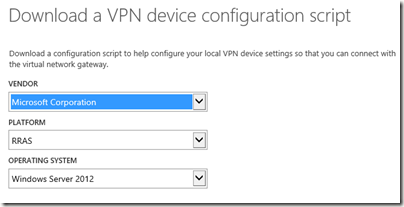
After the linking the Virtual Network, an option Get Script becomes available which allows you to download a PowerShell script you can run on your on premises VPN device or server to be able to accomplish the site-to-site VPN with Microsoft Azure. In my case I use Microsoft RRAS on Windows Server 2012 R2.
image

If you run the script on your on premises RRAS server a VPN will be configured for you.

image

Make sure the VPN is enabled and connectedimage

The next step is to provide the credentials to connect to your local Active Directory domain to allow Azure RemoteApp to add new RD Session Host servers to your domain, in the OU you provided. Obviously the specified account needs the appropriate permissions.

image

Next, we link the RD Session Host image. In this case I re-used a previously uploaded image that I also used for a Cloud Deployment.

image

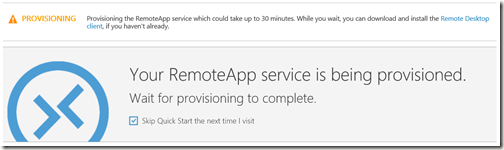
Shortly after you perform this step, Microsoft Azure will start to provision the deployment including the creation of your RD Session Host servers, based on the template. As the warning states, this can take up to 30 minutes.
image

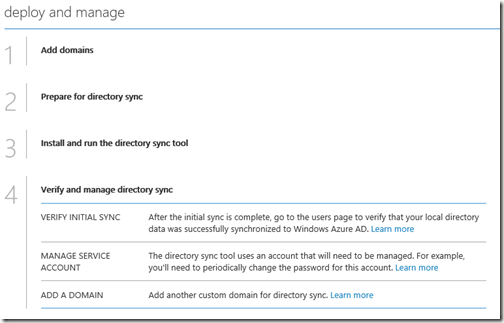
In the mean time you can configure the Directory Synchronization between your on premises Active Directory and Azure Active Directory (AAD) which is needed to be able to assign users and groups to your published Remote Apps and allow users to authenticate to the Azure Remote App Client using their corporate credentials.

If not already in place, you need to create a new AAD in Azure and enable Activate Directory Sync on it. Microsoft Azure guides you through the process by outlining the required steps as shown below.
image

Again, I wont go over all steps in great details, please follow the Microsoft guides as referred to in the introduction of the blog post.

Once you have created the AAD, you download and run the directory sync tool on your on premises server.

image

A wizard which is launched right after the setup allows to you to configure the directory synchronization and perform the initial synchronization. You’ll need to provide your AAD credentials (a user with global admin permissions) and your on premises service account.

Once this wizard is finished an initial sync will take place and you should be able to see your users / groups in AAD become available.

image

Using PowerShell you can also manually trigger synchronization by running the command Start-OnlineCoexistenceSync

image

If synchronization does not correctly function, check the Application Event log for more details on the various synchronization steps.

image

In the mean time you Azure RemoteApp will probably be provisioned. This means we can now perform the final steps: publishing applications and configuring user access.

image

Publishing applications is very straight forward. Simply select the desired applications, notice that I also installed some custom test application in my RD Session Host template which I’m able to select here as well.

image

Or, add published applications by specifying a name and full path to the executable.

image

When you are done publishing Remote Apps, the final step is to configure who is allowed to connect and launch your remote apps.

You can add individual users, but it’s obviously more convenient to select a group of users. In my cased I provided the name of a group I created in my on premises environment which was synced to AAD. (note that you can only add Users & Groups here that are already synced).

image

We’re done. We can now use the Azure RemoteApp client on our endpoint device, and provide our corporate UPN and password. image
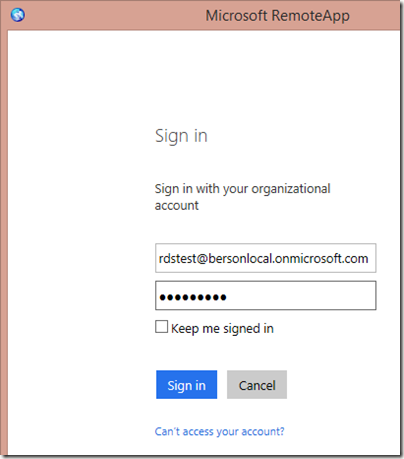
In this case I used the subdomain that comes with AAD (<yourAAD>.onmicrosoft.com) but you can also link your corporate domain by adding it and running the domain verification process which is done via a TXT DNS value you need to configure.

image

And here my are Remote Apps available and ready to launch, hosted by Azure RemoteApp Session Host servers, which are domain joined to my on premises domain!

image

Since this is a Hibrid Deployment, I’m able to access resources that are on premises. I can for example can create a drivemapping pointing to a server running on premises from within my published Remote App (cmd.exe).

image

Also note that my printers are being redirected using Easy Print. USB redirection is  however not supported at this moment.

image

3. A CLOSER LOOK
Now that we have the hybrid deployment up and running, and are able to launch Remote Apps, let’s take a closer look at what happens in your on premises environment.

After the initial RemoteApp deployment has been provisioned, 2 RD Session Host servers have been provisioned and have been joined to the on premises AD domain. A random hostname prefix is selected followed by a number 0000, 0001 etc.

image

The IP-addresses are handled by Microsoft Azure, and based on the Virtual Network Address Space that we configured in Azure as part of the vNet, a DHCP server is used to supply IP-addresses starting by .20 and going up.

image

An IPconfig on one of the RD Session Host servers shows the DHCP server, apparently 168.63.129.16 and also notice the reddog.microsoft.com DNS Suffix, which was the the original code name for Azure. :)

image

A check on port 3389 shows that both RD Session Host servers are available and shortly after the initial provisioning.

image

Shortly after that however, the 1st RD Session Host becomes unavailable.

image

I’m assuming the VM is being put in pause as part of the elastic growing and shrinking mechanism since no user is logged on to the deployment.

As soon as the first users are logging on, a 3rd RD Session Host server is provisioned and after that being put into pause.

image

Furthermore the 2nd RD Session Host server now becomes available again too.

image

To summarize, at this point we have:

- 1 provisioned RDSH server which is accessible and contains active sessions.
- 1 provisioned RDSH server which is accessible but does not accept new sessions (yet)
- 1 provisioned RDSH Server which is not accessible (in pause mode)

When we start hitting the deployment with more users we discover that the first 5 users are being send to the 1st RD Session Host, the 6th user is being redirected to the 2nd RD Session Host servers. So apparently the configuration is max 5 users per RD Session Host server. And, as soon as we logon the 6th user, the 3rd RD Session Host server becomes accessible (but does not get new sessions yet). Etc.

This is how the elastic growing and shrinking is configured at the moment. Obviously Azure Remote Apps is still in Preview so these variables might be changed after General Availability. Who knows, we might even be able to configure this variable in upcoming releases? :)

4. TO CONCLUDE

These are some of the thing I’ve tested in my hybrid deployment so far. In this blog post I tried to give you a more detailed look on how the Hybrid scenario works, specifically how the elastic growing & shrinking works. Obviously there is still a lot more to discuss like performance when accessing your on premises servers, support for GPU, desktop integration, etc.

Personally I really like the concept of Azure Remote Apps, compared to other DaaS offerings this much more of a “It’s all about the apps” solution. Over a decade ago people were already talking about how Windows applications would all be gone in the future, replaced by Web Applications. In 2014 this is still not the case, and it probably won’t be for many years to come. Azure Remote Apps can fill the gaps there, by offering your (corporate) Windows Applications side by side with web based applications or specific locally running applications, accessible from any device at any time. There is however a long way ahead, Azure RemoteApp is currently still into preview. At this point there are no details in pricing yet, good pricing will be crucial in making Azure RemoteApp a success. And, although the Cloud Deployment setup is relatively straight easy and forward, The hybrid Deployment takes a lot of different (sometimes unstructured) steps to set it up. Hopefully Azure RemoteApp will inherit the extremely fast updating speed used in other Azure services to help make it a success.

To finish this blog post, a funny screenshot….I’m sure any sys admin has seen this pop up before, but in this case apparently, the provisioned Azure RemoteApp RD Session Host servers are equipped with temp licenses that last 10 years :)

image